

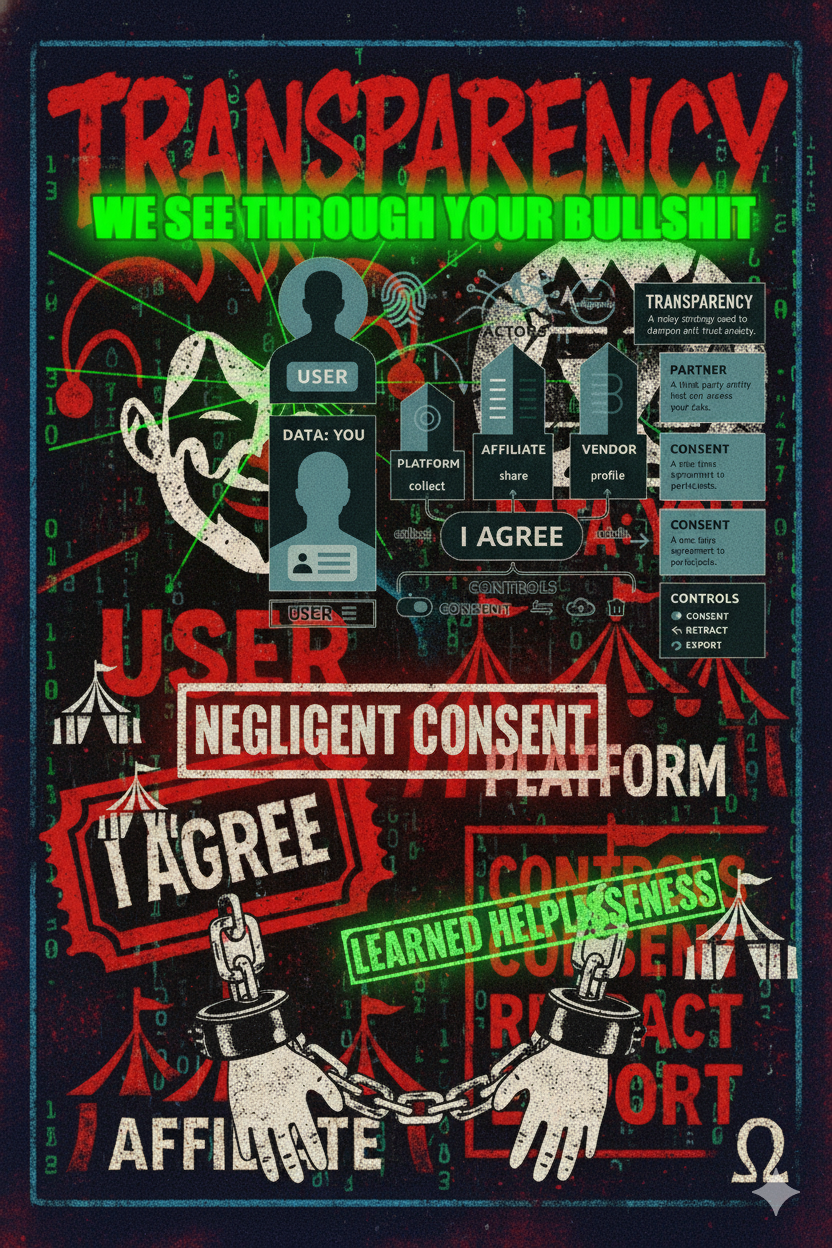
Transparency is the most over-advertised virtue of the digital age. But is it a virtue? Every website weaponizes it. Most privacy policies don’t offer Blessed Assurance; they seethe with Malevolent Malice. And you agree to it.
They offer rituals of clarity that only obfuscate the real power dynamic: your negligent agreement versus their cognitive warfare. These policies aren’t designed to be read. They’re designed to be felt—as noise, like the static from an AM radio. (Fun fact: grab ahold of the tower with both hands and become the speaker). They use fuck-friendly keywords as tranquilizers for the anxious consumer mind, masking legalese that could be written in the buffoonery of an alien tongue.
“Transparency” has become a strategic shield—proof of compliance that ignores conscience. Its real function is to neutralize suspicion while preserving the blind acceptance that breeds learned helplessness. The reflux of antitrust anxiety haunts every sterile paragraph. Do you know what antitrust even means? I didn’t, until I looked it up just now. These policies are the legal architecture for a global conspiracy of monopolies, a constant, coordinated, one-sided psychological fucking.
They are crafted like Cold War treaties: disclosing enough to look open, but never enough to expose true alliances. Phrases like “we may share data with select affiliates” are not mere vagueness; they are deliberate antitrust choreography. By keeping “partners” undefined, companies prevent regulators from tracing the neural network of data pipelines that reveals their anti-competitive advantage. The irony is surgical: the more cautious the language, the more dishonest the intent. Ambiguity isn’t a communication flaw; it’s a compliance tactic. It is a purposeful bliss that makes us ignorant of what privacy even is—a contract we willingly sign to get fucked out of our own core.
Enter the next mutation: “trustworthy transparency”—the illusion that saying anything equals saying something.
Psychologically, it works because the human brain craves shortcuts. Studies show that fewer than 10% of users ever open a privacy policy; fewer than 2% read them through. Ask your bartender; they’ll shrug and say, “I’ve not read a single one.” Our species simply doesn’t have the patience to untangle legal syntax pretending to be ethical prose. This cognitive bias is the corporations’ greatest asset. They publish documents so long, so numbing, that the mere act of their existence becomes their credibility. You see the link, assume decency, and click “I Agree.” If I posted a policy that said, “Fuck me in the ass every day, any way you’d like,” and you were like me, the “I agree” button couldn’t be big enough.
Everyone performs their role: the user feels informed, the company appears compliant, and regulators applaud the presence of words no one understands.
Antitrust law is supposed to protect consumers from monopolies. “Trustworthy transparency” protects monopolies from consumers.
We now live inside a new feudal system: an oligopoly of monopolized data. Each company reigns over a different province of your psyche.
One owns your searches.
Another owns your purchases.
Another your social graph, your sleep pattern, your heart rate, and everything else you let blink on your wrist.
Individually, each is a monopoly over a single behavioral domain. Together, they form a silent alliance of surveillance—an economy of selves where your identity is collateral. They don’t even need to collude. Their dominance is emergent. Each siloed empire harvests its own citizens, then trades anonymized likenesses across networks for profit. Before you know it, your sister gets a call from a debt-bot you neglected to pay 15 years ago. You are commodified at the molecular level of your behavior.
Cyber-psychologically, this ecosystem breeds resignation. Users know they’re being watched, yet continue to participate because non-participation equals social exile. This is learned helplessness as a service. The system monetizes your compliance, your negligence, and your exhaustion. The illusion of choice keeps it running. Sure, you can switch platforms, but you can’t export your behavioral shadow. Your data doesn’t travel with you—it remains, alive and valuable, long after you’ve “left.”
If transparency is to mean anything again, it must evolve beyond theater.
Comprehensibility over compliance. Write for cognition, not litigation.
Define every actor. A “partner” is not a friend.
Make consent ongoing. Let users retract, not just agree.
Until that shift happens, we must break the cycle ourselves. All that’s needed is to just read.
You can read, can’t you?

Leave a Reply