
Author: Jordan “Omegalit” S.

  • Predatory Privacy Policies

    Predatory Privacy Policies

    Literary Assistant = Multiple LLMs

    Can you tell between AI-generated text and Genuine Shit?


    Part 1: The Architecture of Extraction


    Why is renting expensive as fuck? Weekly payments cost more than the rental.

    This is the first installment of a three-part series examining how privacy policies operate inside the rent-to-own industry as a case study for a broader pattern in consumer finance. Part 1 maps the architecture: what data gets collected, where it goes, and what the “sharing” language in published policies actually authorizes.

    “TOO FUCKIN LONG; NOT GONNA READ!”

    If a business asks for your income, your residence history, your references, and a government ID scan to lease a couch, that paperwork is doing more than just approving. It is feeding a data ecosystem in which behavioral, financial, and identity information moves among vendors, marketers, fraud-prevention firms, and analytics partners in language that most policies never make legible. Read a privacy policy as part of the price tag — because in measurable economic terms, it is.

    What this post is (and isn’t)

    This is consumer education and structural commentary on industry patterns. It is not legal advice and does not accuse any specific company of violating any specific law. Where companies are referenced, they appear as examples of an industry-wide pattern, and any reader is encouraged to verify current practices by reading the company’s published privacy policy directly and noting the date of access.

    The Profitable as Fuck Risk Model // NO CREDIT NO PROBLEM!

    A subscription service collects an email address and a card number. A retail loyalty program collects a phone number. Rent-to-own operates on a more invasive, frequent-contact model: the business ships durable goods—appliances, electronics, furniture (bed bug-free!)—to the contract’s home in exchange for the promise of weekly, biweekly, or monthly payments over the term of the rental contract. The merchandise sits in the customer’s possession before the business has been paid in full. That inversion of typical retail risk is what licenses the application’s depth.
    A standard rent-to-own application typically requests, at minimum, a verifiable income source, stable and acceptable residence, multiple personal references at separate addresses (often heavily suggesting to include relatives because that shit’s going to efface their risk), an ID card of some sort, and the applicant’s date of birth and Social Security number for identity and credit verification (of course the credit is just to make sure that you’re not attempting fraud). Application flows mediated by mobile devices or in-store tablets often add device telemetry and, in some cases, biometric identifiers from ID-capture systems. Together, these constitute what privacy researchers describe as a high-resolution identity profile — far more diligent than the data captured by most consumer-facing services (Christl & Spiekermann, 2016).
    The customer experiences this collection as a source of friction: paperwork to be endured to take the merchandise home today. Merchandise that’s critical to furnishing a comfortable living space; Sofas, Television, Washer & Dryer, Fridge, Home Computer, a fuckin Bed, it’s expensive shit people desperately need (and not typically the kind of stuff one wants to collect off the side of the road…usually.)
    Each completed application produces a structured record that has utility well beyond the underwriting decision. The Federal Trade Commission’s foundational report on the data broker industry documented that …

    A man sits despondently on a luxurious, tufted brown leather sectional sofa in a dimly lit room. He is leaning forward with his head down, barefoot, and dressed in simple grey loungework. The floor around him is cluttered with a typewriter and numerous scattered papers prominently labeled "BILL," "NOTICE," and "BILL NOTICES." The contrast between the opulent furniture and the overwhelming evidence of financial distress highlights a sense of irony and despair.

    …consumer-finance application data is among the most commercially valuable categories of personal information precisely because it links identity, location, employment, and financial behavior in a single verified record
    (Federal Trade Commission, 2014).


    Where Your Shit Actually Goes // “Vendors, Service Providers, Affiliates, and Partners”

    “Vendors, service providers, affiliates, and partners“— appear in nearly every rent-to-own privacy policy published today. It reads like nothing. It authorizes everything, so why not just say ”Everybody in the World?“because affiliates and partners are the critical factor, basically eliminating all the risk to lease expensive shit despite shit for credit.

    Because those affiliates and partners are going to really allow you and your lucky number of familial references the perfect opportunity to memorize what the different SPAM filters your devices support, because the affiliates and partners are partners that get a hard on for all of that precious Metadata you just provided about your current ’finally-financially-somewhat-stable-getting-back-on-your-feet-living-situation’ those FUCKS ‘Pimp Your Data’ out to the most annoying and relentless debt collection network that’s purchased your debt’s to pennies on the dollar, and paid a premium to the rent-to-own corporate headquarters to find your ass because they know where that shit credit goes to buy nice shit. This feels like a trap that became a recognizable pattern the second time this happened to me, when 5 years separated a binge of debt collection calls that would call the same older sister, annoyed as fuck that I wasn’t answering the debt collectors, because for some reason… she needed to have voicemail storage space and those 2-minute-long colorful voicemails accumulated quickly.
    Each word is a category containing dozens of companies the customer never identified, never contracted with, and will never audit.

    Cookies be makin’ my browser obese

    Service providers mean payment processors, cloud hosting providers, fraud-prevention vendors, and identity-verification services. Each has its own retention policy and downstream sharing arrangements. You can’t inspect any of them.
    Vendors and partners mean ad-tech infrastructure: retargeting platforms, email marketers, and the programmatic advertising auction operated by Google, Meta, TikTok, and adjacent companies. Your behavioral data enters that system and gets used to target you across thousands of unrelated sites. Rent-A-Center’s own published cookie disclosure names twelve advertising partners by name — including Meta, Google, TikTok, Pinterest, Yahoo, Microsoft Bing, Pandora, Zeta, AppNexus/Xandr, Verizon/Oath, Causal IQ, and Claritas (Upbound Group, Inc., 2025). Twelve companies are watching one rental application. Cookie Monsters Series coming down the pipeline!

    Nonexistent Entities Entitled Existence

    Affiliates mean corporate parent and subsidiary entities. For Rent-A-Center, that’s Upbound Group, Inc., and every current or future subsidiary under its umbrella. Their policy says it plainly: “all information gathered about you by the Company may be shared with any of the Company’s current or future subsidiaries or affiliates“(Upbound Group, Inc., 2025). Current or future. Entities that don’t exist yet already have authorization to receive your data. You signed one form to lease a couch. That sentence authorized data flow to every entity above, plus any entity that acquires the company after the fact.

    And here’s the one that should make you put your phone down for a second: the same policy discloses that in the event of “bankruptcy, insolvency, or dissolution proceedings,” your personal information may be shared with third parties as part of the sale or reorganization process (Upbound Group, Inc., 2025). If the company goes under, your data is an asset on the auction block. Imagine your bankrupt bullshit 420 credit score is the secret ingredient keeping a CEO’s Timeshare resort in Malaysia current with its Maintenance Fees.

    References

    Christl, W., & Spiekermann, S. (2016). Networks of control: A report on corporate surveillance, digital tracking, big data & privacy. Facultas.

    Federal Trade Commission. (2014). Data brokers: A call for transparency and accountability. https://www.ftc.gov/system/files/documents/reports/data-brokers-call-transparency-accountability-report-federal-trade-commission-may-2014/140527databrokerreport.pdf

    Upbound Group, Inc. (2025, January 1). Rent-A-Center privacy policy. https://www.rentacenter.com/privacy-policy [Accessed April 16, 2026]
  • The Service of Learned Helplessness

    The Service of Learned Helplessness

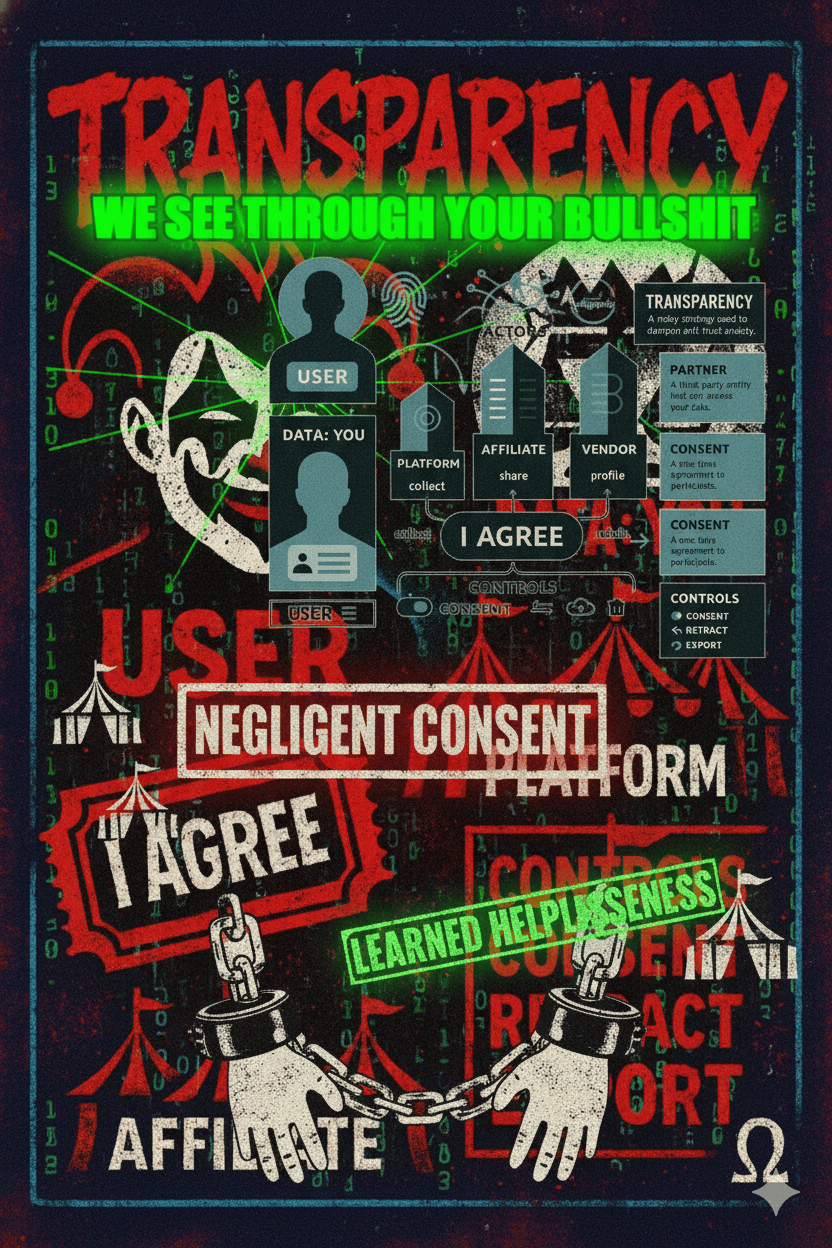
    Transparency is the most over-advertised virtue of the digital age. But is it a virtue? Every website weaponizes it. Most privacy policies don’t offer Blessed Assurance; they seethe with Malevolent Malice. And you agree to it.
    They offer rituals of clarity that only obfuscate the real power dynamic: your negligent agreement versus their cognitive warfare. These policies aren’t designed to be read. They’re designed to be felt—as noise, like the static from an AM radio. (Fun fact: grab ahold of the tower with both hands and become the speaker). They use fuck-friendly keywords as tranquilizers for the anxious consumer mind, masking legalese that could be written in the buffoonery of an alien tongue.
    “Transparency” has become a strategic shield—proof of compliance that ignores conscience. Its real function is to neutralize suspicion while preserving the blind acceptance that breeds learned helplessness. The reflux of antitrust anxiety haunts every sterile paragraph. Do you know what antitrust even means? I didn’t, until I looked it up just now. These policies are the legal architecture for a global conspiracy of monopolies, a constant, coordinated, one-sided psychological fucking.
    They are crafted like Cold War treaties: disclosing enough to look open, but never enough to expose true alliances. Phrases like “we may share data with select affiliates” are not mere vagueness; they are deliberate antitrust choreography. By keeping “partners” undefined, companies prevent regulators from tracing the neural network of data pipelines that reveals their anti-competitive advantage. The irony is surgical: the more cautious the language, the more dishonest the intent. Ambiguity isn’t a communication flaw; it’s a compliance tactic. It is a purposeful bliss that makes us ignorant of what privacy even is—a contract we willingly sign to get fucked out of our own core.
    Enter the next mutation: “trustworthy transparency”—the illusion that saying anything equals saying something.
    Psychologically, it works because the human brain craves shortcuts. Studies show that fewer than 10% of users ever open a privacy policy; fewer than 2% read them through. Ask your bartender; they’ll shrug and say, “I’ve not read a single one.” Our species simply doesn’t have the patience to untangle legal syntax pretending to be ethical prose. This cognitive bias is the corporations’ greatest asset. They publish documents so long, so numbing, that the mere act of their existence becomes their credibility. You see the link, assume decency, and click “I Agree.” If I posted a policy that said, “Fuck me in the ass every day, any way you’d like,” and you were like me, the “I agree” button couldn’t be big enough.
    Everyone performs their role: the user feels informed, the company appears compliant, and regulators applaud the presence of words no one understands.
    Antitrust law is supposed to protect consumers from monopolies. “Trustworthy transparency” protects monopolies from consumers.
    We now live inside a new feudal system: an oligopoly of monopolized data. Each company reigns over a different province of your psyche.
    One owns your searches.
    Another owns your purchases.
    Another your social graph, your sleep pattern, your heart rate, and everything else you let blink on your wrist.
    Individually, each is a monopoly over a single behavioral domain. Together, they form a silent alliance of surveillance—an economy of selves where your identity is collateral. They don’t even need to collude. Their dominance is emergent. Each siloed empire harvests its own citizens, then trades anonymized likenesses across networks for profit. Before you know it, your sister gets a call from a debt-bot you neglected to pay 15 years ago. You are commodified at the molecular level of your behavior.
    Cyber-psychologically, this ecosystem breeds resignation. Users know they’re being watched, yet continue to participate because non-participation equals social exile. This is learned helplessness as a service. The system monetizes your compliance, your negligence, and your exhaustion. The illusion of choice keeps it running. Sure, you can switch platforms, but you can’t export your behavioral shadow. Your data doesn’t travel with you—it remains, alive and valuable, long after you’ve “left.”
    If transparency is to mean anything again, it must evolve beyond theater.
    Comprehensibility over compliance. Write for cognition, not litigation.
    Define every actor. A “partner” is not a friend.
    Make consent ongoing. Let users retract, not just agree.
    Until that shift happens, we must break the cycle ourselves. All that’s needed is to just read.
    You can read, can’t you?

    Leave a Reply

    Rating: 1 out of 5.
  • Letting Go in the Digital Age: Embrace the Present

    Letting Go in the Digital Age: Embrace the Present

    Letting go of the past used to be a rather spiritual concept. You’d stash away a photo album, toss out a letter, maybe even burn a keepsake—and that was that. The memories drifted away like an old house fading in your rearview mirror. But these days? Now your phone buzzes with reminders—“Remember this day?”—and suddenly, the past barges in, as if it’s right there in front of you.
    Google Photos, OneDrive, Facebook Memories—these services are essentially algorithmic necromancers, conjuring ghosts we never asked to see. A picture of someone you lost. A night when you still believed in forever. A child when they still fit in your arms. A version of yourself who smiled with less weight behind their eyes.
    And you sit there, blinking at that damn glowing screen, torn between two lives—
    The one that was
    …and the one that is.
    Cyberpsychology has a term for this phenomenon:
    Digital Liminality
    It’s that psychological state we enter when we’re trapped between timelines, suspended in the emotional vertigo of past and present. The interface becomes an altar of nostalgia—worshipping what’s been lost, never recovered, sometimes regretted.
    It’s important to acknowledge this: you can’t live in the past. However, what lies ahead holds endless possibilities. You can’t revert back to who you once were, but you can look forward to becoming someone even more remarkable.
    The version of reality you once longed for?
    It won’t ever exist again; letting go of grasping onto a forced, fucked attempt at recreating a world of yours as it was before isn’t possible. The hardest part of letting go is realizing that you’re holding on in the first place. The reward is a commitment toward growth.
    Memories will wither away, yet the emotions they evoke will ignite when the notification reminding you of “this day 20 years ago” appears on your device. There will be a time when scrolling through those terabytes of images taken throughout your life will become the favorite stories shared with those who have eager ears.
    Plus, being old as fuck probably sucks, and the best way to feel happy is to see a 2-hour slideshow of you young and happy.
    But if there’s no effort made to let go of the frantic wish to keep things the same, as they inevitably become worse and fall apart, then that slideshow becomes incredibly short. Smile more now so that you will always be able to when the whole life ahead of you becomes “the little time you have left.”

    Savor the now because it will become the past.

  • Digital Ghosts: Memories on the Home Screen

    Digital Ghosts: Memories on the Home Screen

    2–3 minutes

    /

    A Cyber-Psychological Reflection on Letting Go in the Age of Algorithms

    You don’t really get to forget in the digital era.
    Not entirely.

    Letting go of the past used to be a rather spiritual concept. You’d stash away a photo album, toss out a letter, maybe even burn a keepsake—and that was that. The memories drifted away like an old house fading in your rearview mirror. But these days? Now your phone buzzes with reminders—“Remember this day?”—and suddenly, the past barges in, as if it’s right there in front of you.

    Google Photos, OneDrive, Facebook Memories—these services are essentially algorithmic necromancers, conjuring ghosts we never asked to see. A picture of someone you lost. A night when you still believed in forever. A child when they still fit in your arms. A version of yourself who smiled with less weight behind their eyes.
    And you sit there, blinking at that damn glowing screen, torn between two lives—
    The one that was
    …and the one that is.

    Cyberpsychology has a term for this phenomenon:

    Digital Liminality

    It’s that psychological state we enter when we’re trapped between timelines, suspended in the emotional vertigo of past and present. The interface becomes an altar of nostalgia—worshipping what’s been lost, never recovered, sometimes regretted.

    It’s important to acknowledge this: you can’t live in the past. However, what lies ahead holds endless possibilities. You can’t revert back to who you once were, but you can look forward to becoming someone even more remarkable.

    The version of reality you once longed for?

    It won’t ever exist again; letting go of grasping onto a force fucked attempt at recreating a world of yours as it was before isn’t possible. The hardest part of letting go is realizing that you’re holding on in the first place. The reward is a commitment towards growth.

    Savor the now because it will become the past.

    Memories will wither away, yet the emotions they evoke will ignite when the notification reminding you of “this day 20 years ago” appears on your device. There will be a time when scrolling those Terabytes of images taken throughout your life will become the favorite stories shared to those with eager ears.
    Plus, being old as fuck probably sucks, and the best way to feel happy is to see a 2-hour slideshow of you young and happy.
    But if there’s no effort made to let go of the frantic wish to keep things the same, as they inevitably become worse and fall apart, then that slideshow becomes incredibly short. Smile more now so that you will always be able to when the whole life ahead of you becomes “the little time you have left.”

  • Omega’s Weekly Blog

    Subscribe to continue reading

    Subscribe to get access to the rest of this post and other subscriber-only content.