Blog

  • The Service of Learned Helplessness

    The Service of Learned Helplessness

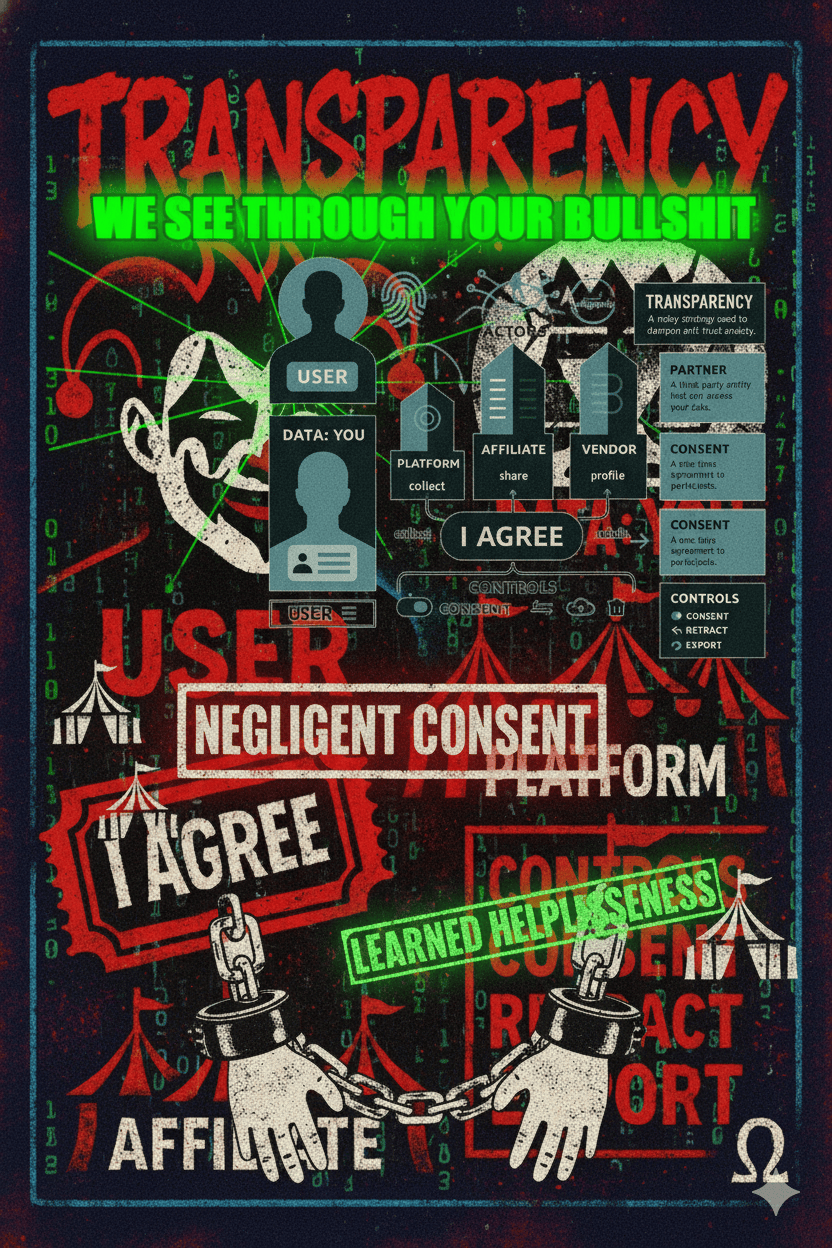
    Transparency is the most over-advertised virtue of the digital age. But is it a virtue? Every website weaponizes it. Most privacy policies don’t offer Blessed Assurance; they seethe with Malevolent Malice. And you agree to it.
    They offer rituals of clarity that only obfuscate the real power dynamic: your negligent agreement versus their cognitive warfare. These policies aren’t designed to be read. They’re designed to be felt—as noise, like the static from an AM radio. (Fun fact: grab ahold of the tower with both hands and become the speaker). They use fuck-friendly keywords as tranquilizers for the anxious consumer mind, masking legalese that could be written in the buffoonery of an alien tongue.
    “Transparency” has become a strategic shield—proof of compliance that ignores conscience. Its real function is to neutralize suspicion while preserving the blind acceptance that breeds learned helplessness. The reflux of antitrust anxiety haunts every sterile paragraph. Do you know what antitrust even means? I didn’t, until I looked it up just now. These policies are the legal architecture for a global conspiracy of monopolies, a constant, coordinated, one-sided psychological fucking.
    They are crafted like Cold War treaties: disclosing enough to look open, but never enough to expose true alliances. Phrases like “we may share data with select affiliates” are not mere vagueness; they are deliberate antitrust choreography. By keeping “partners” undefined, companies prevent regulators from tracing the neural network of data pipelines that reveals their anti-competitive advantage. The irony is surgical: the more cautious the language, the more dishonest the intent. Ambiguity isn’t a communication flaw; it’s a compliance tactic. It is a purposeful bliss that makes us ignorant of what privacy even is—a contract we willingly sign to get fucked out of our own core.
    Enter the next mutation: “trustworthy transparency”—the illusion that saying anything equals saying something.
    Psychologically, it works because the human brain craves shortcuts. Studies show that fewer than 10% of users ever open a privacy policy; fewer than 2% read them through. Ask your bartender; they’ll shrug and say, “I’ve not read a single one.” Our species simply doesn’t have the patience to untangle legal syntax pretending to be ethical prose. This cognitive bias is the corporations’ greatest asset. They publish documents so long, so numbing, that the mere act of their existence becomes their credibility. You see the link, assume decency, and click “I Agree.” If I posted a policy that said, “Fuck me in the ass every day, any way you’d like,” and you were like me, the “I agree” button couldn’t be big enough.
    Everyone performs their role: the user feels informed, the company appears compliant, and regulators applaud the presence of words no one understands.
    Antitrust law is supposed to protect consumers from monopolies. “Trustworthy transparency” protects monopolies from consumers.
    We now live inside a new feudal system: an oligopoly of monopolized data. Each company reigns over a different province of your psyche.
    One owns your searches.
    Another owns your purchases.
    Another your social graph, your sleep pattern, your heart rate, and everything else you let blink on your wrist.
    Individually, each is a monopoly over a single behavioral domain. Together, they form a silent alliance of surveillance—an economy of selves where your identity is collateral. They don’t even need to collude. Their dominance is emergent. Each siloed empire harvests its own citizens, then trades anonymized likenesses across networks for profit. Before you know it, your sister gets a call from a debt-bot you neglected to pay 15 years ago. You are commodified at the molecular level of your behavior.
    Cyber-psychologically, this ecosystem breeds resignation. Users know they’re being watched, yet continue to participate because non-participation equals social exile. This is learned helplessness as a service. The system monetizes your compliance, your negligence, and your exhaustion. The illusion of choice keeps it running. Sure, you can switch platforms, but you can’t export your behavioral shadow. Your data doesn’t travel with you—it remains, alive and valuable, long after you’ve “left.”
    If transparency is to mean anything again, it must evolve beyond theater.
    Comprehensibility over compliance. Write for cognition, not litigation.
    Define every actor. A “partner” is not a friend.
    Make consent ongoing. Let users retract, not just agree.
    Until that shift happens, we must break the cycle ourselves. All that’s needed is to just read.
    You can read, can’t you?
    Leave a Reply

    Rating: 1 out of 5.
  • Letting Go in the Digital Age: Embrace the Present

    Letting Go in the Digital Age: Embrace the Present

    Letting go of the past used to be a rather spiritual concept. You’d stash away a photo album, toss out a letter, maybe even burn a keepsake—and that was that. The memories drifted away like an old house fading in your rearview mirror. But these days? Now your phone buzzes with reminders—“Remember this day?”—and suddenly, the past barges in, as if it’s right there in front of you.
    Google Photos, OneDrive, Facebook Memories—these services are essentially algorithmic necromancers, conjuring ghosts we never asked to see. A picture of someone you lost. A night when you still believed in forever. A child when they still fit in your arms. A version of yourself who smiled with less weight behind their eyes.
    And you sit there, blinking at that damn glowing screen, torn between two lives—
    The one that was
    …and the one that is.
    Cyberpsychology has a term for this phenomenon:
    Digital Liminality
    It’s that psychological state we enter when we’re trapped between timelines, suspended in the emotional vertigo of past and present. The interface becomes an altar of nostalgia—worshipping what’s been lost, never recovered, sometimes regretted.
    It’s important to acknowledge this: you can’t live in the past. However, what lies ahead holds endless possibilities. You can’t revert back to who you once were, but you can look forward to becoming someone even more remarkable.
    The version of reality you once longed for?
    It won’t ever exist again; letting go of grasping onto a forced, fucked attempt at recreating a world of yours as it was before isn’t possible. The hardest part of letting go is realizing that you’re holding on in the first place. The reward is a commitment toward growth.
    Memories will wither away, yet the emotions they evoke will ignite when the notification reminding you of “this day 20 years ago” appears on your device. There will be a time when scrolling through those terabytes of images taken throughout your life will become the favorite stories shared with those who have eager ears.
    Plus, being old as fuck probably sucks, and the best way to feel happy is to see a 2-hour slideshow of you young and happy.
    But if there’s no effort made to let go of the frantic wish to keep things the same, as they inevitably become worse and fall apart, then that slideshow becomes incredibly short. Smile more now so that you will always be able to when the whole life ahead of you becomes “the little time you have left.”

    Savor the now because it will become the past.

  • Digital Ghosts: Memories on the Home Screen

    Digital Ghosts: Memories on the Home Screen

    2–3 minutes

    /

    A Cyber-Psychological Reflection on Letting Go in the Age of Algorithms

    You don’t really get to forget in the digital era.
    Not entirely.

    Letting go of the past used to be a rather spiritual concept. You’d stash away a photo album, toss out a letter, maybe even burn a keepsake—and that was that. The memories drifted away like an old house fading in your rearview mirror. But these days? Now your phone buzzes with reminders—“Remember this day?”—and suddenly, the past barges in, as if it’s right there in front of you.

    Google Photos, OneDrive, Facebook Memories—these services are essentially algorithmic necromancers, conjuring ghosts we never asked to see. A picture of someone you lost. A night when you still believed in forever. A child when they still fit in your arms. A version of yourself who smiled with less weight behind their eyes.
    And you sit there, blinking at that damn glowing screen, torn between two lives—
    The one that was
    …and the one that is.

    Cyberpsychology has a term for this phenomenon:

    Digital Liminality

    It’s that psychological state we enter when we’re trapped between timelines, suspended in the emotional vertigo of past and present. The interface becomes an altar of nostalgia—worshipping what’s been lost, never recovered, sometimes regretted.

    It’s important to acknowledge this: you can’t live in the past. However, what lies ahead holds endless possibilities. You can’t revert back to who you once were, but you can look forward to becoming someone even more remarkable.

    The version of reality you once longed for?

    It won’t ever exist again; letting go of grasping onto a force fucked attempt at recreating a world of yours as it was before isn’t possible. The hardest part of letting go is realizing that you’re holding on in the first place. The reward is a commitment towards growth.

    Savor the now because it will become the past.

    Memories will wither away, yet the emotions they evoke will ignite when the notification reminding you of “this day 20 years ago” appears on your device. There will be a time when scrolling those Terabytes of images taken throughout your life will become the favorite stories shared to those with eager ears.
    Plus, being old as fuck probably sucks, and the best way to feel happy is to see a 2-hour slideshow of you young and happy.
    But if there’s no effort made to let go of the frantic wish to keep things the same, as they inevitably become worse and fall apart, then that slideshow becomes incredibly short. Smile more now so that you will always be able to when the whole life ahead of you becomes “the little time you have left.”

  • Omega’s Weekly Blog

    Subscribe to continue reading

    Subscribe to get access to the rest of this post and other subscriber-only content.

  • AI Consultant

    AI Consultant

    Often as a child I felt like technology was growing and advancing with me. I learned to read from enveloping myself into RPG’s for NES and SNES, you know, old Nintendo. My first PC was an MS DOS system, a command-line interface Microsoft operating system. I remember feeling very underwhelmed typing in sentences thinking i would get some kind of personal feedback response, i was kind of sad that my PC didnt understand me either, so i tried to understand it instead.
    I learned keywords and had fun getting it to respond with acknowledgement instead of errors, as i was beginning to feel like an error myself for coming to this thing when i got bored. And then i typed in the command to delete an entire hard drive and i panicked, typing in commands, or more like garbled madeup keywords i thought would work with tears in my eyes at the young age of 8 or 9. I finally tried the word “unformat” and sure as shit that brought back all the precious 2 megabytes or so of data. This started a fly by the edge of your seat approach towards pc’s which was my approach towards technology for decades, until recently.

    I bring that story up because it can be okay to haphazardly use a PC as a sandbox and build sand castles and stomp them down making everything as it once was but with a computer just deleting or restoring something looks fine on the surface but on the inside it is scarred. On a windows machine its called the registry and its like the autonomic nervous system, operating in the background as the brain pulling from the registry files to know what to do. Sometimes though if the right registry files are corrupted or missing your pc wont even restart. And it goes into recovery mode. It happened to me once when i was using A.I. to aid in my computer repairs in fixing an error i caused out of impulse and it showed me the registry files to delete and out of lack of caution and distraction I deleted files from the wrong directory and couldnt undo it. This time “unfuck the registry”, my “unformat” magic keyword equivalent didnt work and so luckily I had backups of my data and a clean installation of Windows 10 was the only valid option.