Part 2 of the series of the similar name, how much do you like to read?
Literary assistant = several fuckin’ LLM’s all set to some deep philosophical & intrinsical thought model
Part 2: The Cyberpsychology of “I Agree”
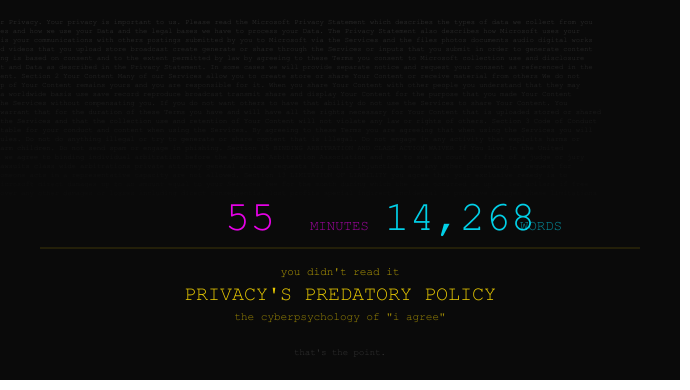
55 minutes. 14,268 words. You didn’t read it. That’s the point.
This is the second installment of a three-part series. Part 1 mapped the architecture of data extraction — what gets collected, where it goes, and what four sentences in a typical privacy policy actually authorize. This part examines why the architecture works: the cyberpsychology of consent under cognitive load, financial pressure, and decision environments engineered to produce compliance. Part 3 builds the countermeasure stack.
What this post is and what it isn’t
Consumer education and structural commentary. Not legal advice, not an accusation against any specific company. Where companies or documents are referenced, they appear as examples of industry-wide patterns, and any reader is encouraged to verify current practices directly.
The 55-minute confession
Microsoft’s consumer Services Agreement — the contract governing Outlook, Xbox, Copilot, Teams, OneDrive, and over a hundred other products — opens with an unusual disclosure. At the top of the document, before any substantive clause, the company prints an estimated reading time: 55 minutes (Microsoft Corporation, 2025). The document contains 14,268 words.
For context, that is longer than most of the academic papers cited in this series.
The company is not hiding the length. It is advertising it.
That disclosure functions as a liability shield:
we told you how long it would take; you chose not to read it.
The document then proceeds to contain a binding arbitration clause and class action waiver (Section 15), a liability cap of $10 for free services (Section 13), [*side note*: I remember reading that for the first time and chuckling about how important money is to people that have it, and how important it is to keep money from the people who are somehow hurt by a companies negligence or salience that something is prone to fucked upedness, and that I’m sure they have a quarterly acceptable loss allowed in the risk assessment matrix, but anyway i digress] broad rights to modify terms unilaterally with continued use constituting acceptance (Section 7), the right to process and store all inputs and outputs to AI services for monitoring (Section 14.s.v), and the right to terminate services and delete user content at any time (Section 4.a.iv).
Every one of those clauses has measurable legal and financial consequences for the user. None of them is readable at the moment of signing.
This is not a failure of the system.
It is the system working as designed.
The impossibility of reading: a quantified problem
The scale of the consent problem is not rhetorical. It has been measured. Ben-Shahar and Schneider (2014), in their foundational study of mandated disclosure regimes, calculated the aggregate reading burden that privacy policies impose on consumers. If an average American internet user attempted to read every privacy policy they encountered in a year, the total time cost would exceed 200 hours — approximately five full workweeks (McDonald & Cranor, 2008). That estimate was published in 2008. The number of services, apps, and platforms requiring consent has increased by an order of magnitude since then.
The problem is not that people are lazy. The problem is that the reading demand is structurally impossible to satisfy. No human being has the time, cognitive bandwidth, or legal training to process the volume of consent documents the digital economy generates. The notice-and-choice framework — the legal architecture that treats “I Agree” as meaningful consent — is built on a fiction: the fiction that a reasonable person reads, comprehends, and meaningfully evaluates the terms before clicking.
Solove (2013) named this the failure of privacy self-management: the regulatory model asks individuals to manage their own privacy through individual consent decisions, while generating a volume and complexity of decisions that no individual can manage. The model does not fail occasionally. It fails categorically, by design, for every user, every time.
Cognitive load: why the brain says “yes” when the answer should be “wait”
The psychological mechanism is well-documented and operates at a level below conscious deliberation.
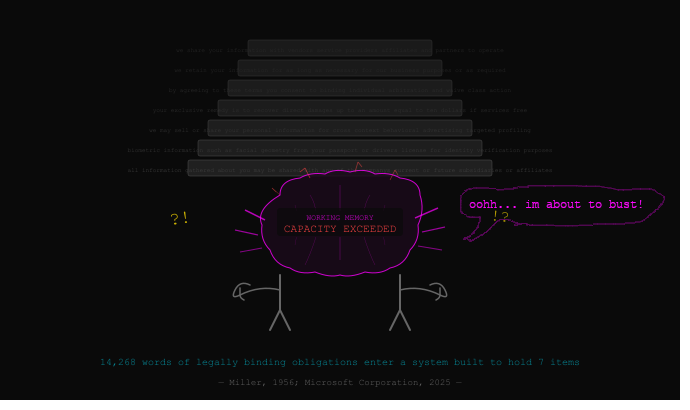
Human decision-making under cognitive load follows predictable patterns. When working memory is saturated — by time pressure, financial stress, information overload, or emotional arousal — the brain shifts from deliberative processing (slow, analytical, effortful) to heuristic processing (fast, intuitive, error-prone). Kahneman (2011) describes this as the shift from System 2 to System 1 thinking. In the context of privacy decisions, this means the user defaults to simple heuristics: “everyone else agreed, so it must be fine”; “this company is well-known, so they must be trustworthy”; “I need this service right now, and reading the policy won’t change anything.”
Acquisti, Brandimarte, and Loewenstein (2015) documented this pattern specifically in privacy behavior, identifying three structural properties that make privacy decisions systematically irrational: information asymmetry (the company knows what the data is worth; the consumer does not), the abstract and probabilistic nature of privacy harms (the damage is future, uncertain, and difficult to trace to any single disclosure), and context dependence (the same person will share or withhold the same information depending on how the choice is framed).
The moment of consent in a rent-to-own store combines all three. The customer is under financial pressure, time pressure, and emotional arousal (that suggestive term just means it’s some shit that you know you need). The privacy policy is long, legalistic, and presented at the exact moment the customer’s cognitive bandwidth is occupied by a different decision: Can I afford this payment schedule? The heuristic kicks in. The box gets checked.
The machine that builds your “yes”
No choice is presented neutrally. Thaler and Sunstein (2008) named this choice architecture — the recognition that the entity structuring a decision shapes its outcome more powerfully than the decision’s content.
Default settings, visual hierarchy, friction distribution — these are not neutral design choices; they are behavioral instruments.
Brignull (2023) cataloged the digital versions: pre-checked consent boxes, double-negative opt-outs, single-click acceptance versus multi-screen resistance. The pattern is straightforward — reaching an agreement happens easily, but understanding each other takes effort, and the imbalance is intentionally designed.
In a rent-to-own store, the conversion funnel is analog, but the exploit is identical. The raw, unprotected privacy policy sits between the legs of the customer and the merchandise. Every design incentive minimizes the time spent on the policy and maximizes the speed to signature. The document is technically available. It is positionally invisible. Calo (2014) calls this digital market manipulation — the systematic use of interface design to exploit cognitive weakness. The rent-to-own application is the same architecture built in paper and social pressure instead of pixels.
Now compound it. The populations most likely to use rent-to-own — paycheck-to-paycheck cash flow, no traditional credit access, housing instability — are the populations whose cognitive bandwidth is most depleted at the moment the policy arrives. Mani et al. (2013) demonstrated that financial scarcity alone reduces available cognitive bandwidth by approximately 13 IQ points. Not intelligence. Bandwidth — the same resource that deliberative decision-making requires. The brain is already maxed out by the financial problem that brought the customer to the store. The privacy policy arrives in a system running on fumes.
Then add shame. The application is a status exposure event — proving you deserve approval despite not having the credit to buy outright. Pausing to read the policy signals suspicion, delays the approval, extends the discomfort. The social pressure to just sign and move on is another cognitive tax stacked on top of the scarcity tax stacked on top of the design tax.
The result: a poverty premium on consent.
The less financial margin you have, the less cognitive margin you have to evaluate what you’re consenting to — and the more valuable your data is to the company extracting it. The system does not exploit everyone equally. It extracts the most from those who can afford to give the least.
Which means “I Agree” is not agreement. Consent requires understanding the terms, having a genuine alternative, and deliberating under conditions that permit it. None of those conditions exist here. The reading burden is structurally impossible. The alternative to consenting is exclusion from the service. Cognitive load, edging itself with financial scarcity and social pressure, has shifted the decision from deliberative to heuristic before the policy is ever presented.
Automatic consent makes you compliant. Informed consent brings reckoning.
References
Acquisti, A., Brandimarte, L., & Loewenstein, G. (2015). Privacy and human behavior in the age of information. Science, 347(6221), 509–514. https://doi.org/10.1126/science.aaa1465
Ben-Shahar, O., & Schneider, C. E. (2014). More than you wanted to know: The failure of mandated disclosure. Princeton University Press.
Brignull, H. (2023). Deceptive patterns: Exposing the tricks tech companies use to control you. Testimonium.
Calo, R. (2014). Digital market manipulation. George Washington Law Review, 82(4), 995–1051.
Kahneman, D. (2011). Thinking, fast and slow. Farrar, Straus and Giroux.
Mani, A., Mullainathan, S., Shafir, E., & Zhao, J. (2013). Poverty impedes cognitive function. Science, 341(6149), 976–980. https://doi.org/10.1126/science.1238041
McDonald, A. M., & Cranor, L. F. (2008). The cost of reading privacy policies. I/S: A Journal of Law and Policy for the Information Society, 4(3), 543–568.
Microsoft Corporation. (2025, July 30). Microsoft Services Agreement. https://www.microsoft.com/en-us/servicesagreement/
Solove, D. J. (2013). Introduction: Privacy self-management and the consent dilemma. Harvard Law Review, 126(7), 1880–1903.
Thaler, R. H., & Sunstein, C. R. (2008). Nudge: Improving decisions about health, wealth, and happiness. Yale University Press


Leave a Reply