// AI disclosure
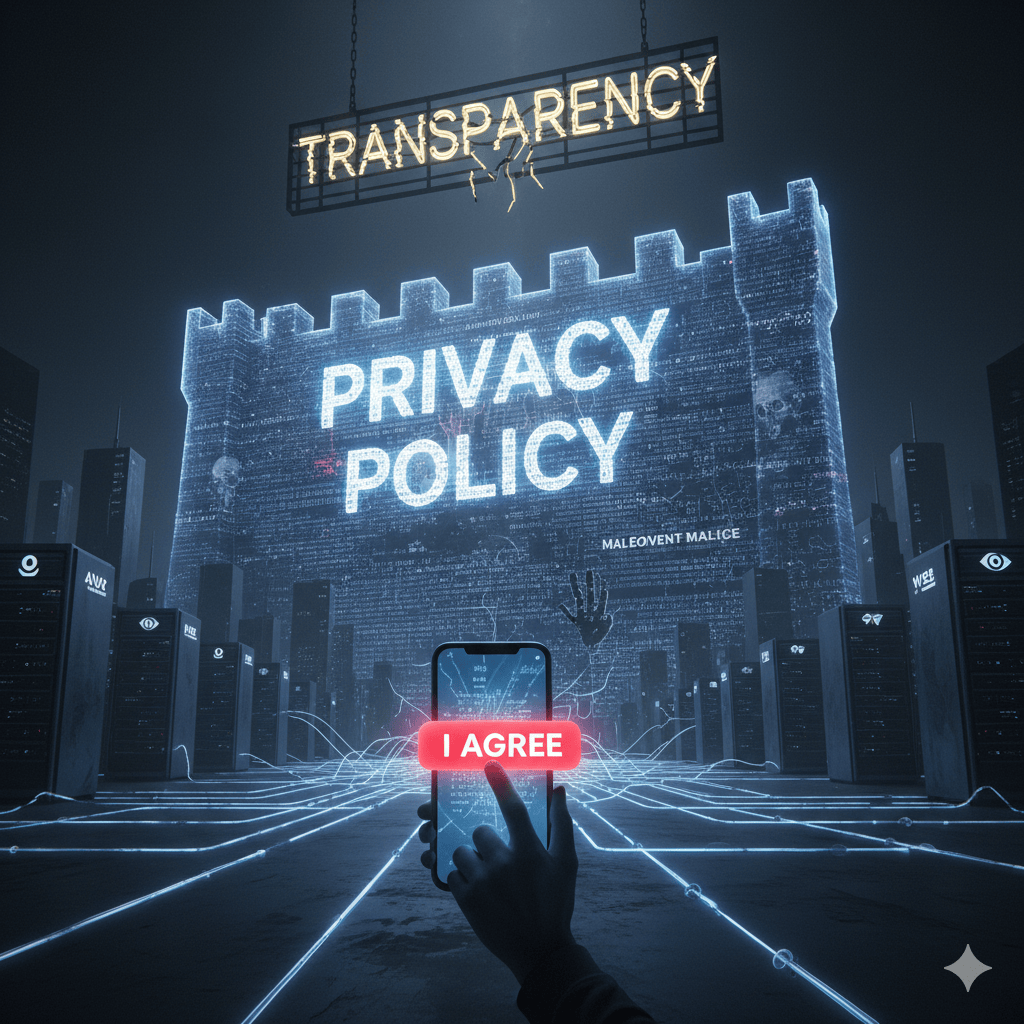
This whole episode is AI generated, Pip and Mara included. I got bored and played with the WordPress toys, and one of them plays with my literary work. Of course it’s confused and sycophantic. Regardless, it’s here for further insight into the Privacy’s Predatory Policy series.
The next blog series, on AI-generated music, is coming in the next few weeks for the weekly blog. It might be weekly, but it might not be. Maybe it is, but likely it won’t be, because ADHD.
Pip: Welcome to Deeez Nuuuts Consulting LLC™, where today's episode is brought to you by the forty-seven companies that already have your data from the last time you leased a couch.
Mara: We are covering the architecture of data extraction, the psychology of manufactured consent, and — finally — a practical countermeasure stack for people who would like to be slightly more expensive to surveil.
Pip: Let's start with how the trap is built and what you can actually do about it.
—
Privacy Extraction And Countermeasures
Mara: The series we are recapping began with a rent-to-own application as a case study — not because furniture leasing is uniquely sinister, but because its data collection is unusually visible. The question across all three parts is: what does that paperwork actually authorize, why do people sign it anyway, and what can a person under real-world cognitive load actually do in response?
Pip: Part 1, covered in Predatory Privacy Policies, establishes the intake form as a data asset. Income, residence history, references, a government ID scan — all of it feeding what the FTC called something specific.
Mara: The Federal Trade Commission's foundational report documented that "consumer-finance application data is among the most commercially valuable categories of personal information precisely because it links identity, location, employment, and financial behavior in a single verified record."
Pip: One verified record. That is the thing being sold. The couch is almost incidental.
Mara: And the sharing language in published policies makes the downstream flow nearly unlimited. Rent-A-Center's own cookie disclosure names twelve advertising partners by name — Meta, Google, TikTok, Pinterest, Yahoo, Microsoft Bing, Pandora, Zeta, AppNexus/Xandr, Verizon/Oath, Causal IQ, and Claritas. Twelve companies watching one rental application.
Pip: Part 2 — also titled Privacy's Predatory Policy — explains why people sign anyway. The answer is cognitive load, and it turns out financial scarcity alone reduces available deliberative bandwidth by roughly thirteen IQ points. The brain is already running on fumes by the time the policy arrives.
Mara: Which brings Part 3 to its central design constraint. The author is explicit: "no countermeasure in this stack is allowed to assume you have free time, legal training, or emotional slack."
Pip: That constraint is doing real work. A defense that requires you to become a different person is not a defense.
Mara: The six layers that follow are built around that limit. Triage four clause types in four minutes instead of reading fifty-five. Use email aliases and a VoIP number to starve the join key that links you across databases. Send deletion requests even if your state has no privacy law, because the economics of compliance pipelines often mean companies honor them anyway.
Pip: Turn on Global Privacy Control — one browser setting, legally mandatory in roughly a dozen states, already backed by multimillion-dollar enforcement actions.
Mara: And the layer the author calls the existential core: obfuscation. Brunton and Nissenbaum describe it as the deliberate production of ambiguous or misleading signals to make surveillance data less valuable. Your loyalty card does not need your real birthday.
Pip: The goal is not invisibility. The author is clear that hiding is unavailable. The goal is resolution degradation — converting yourself from a high-fidelity, cross-checked, monetizable record into something a marketer's model cannot confidently price.
Mara: The final layer is the CFPB complaint database. Filing costs ten minutes. The company must respond within roughly fifteen days, and the complaint becomes a permanent public record that regulators and class-action attorneys mine for patterns. The author's framing: "You spent fifty-five minutes not reading their agreement. Spend ten minutes writing your own entry in the public record."
Pip: The whole series started because a rent-to-own application the author signed years ago is still echoing through a family member's voicemail. The countermeasure stack cannot unsign that. What it changes is the price of the next extraction attempt.
Mara: And that segues to a thread running quietly through all three posts — the author used multiple LLMs as a literary assistant throughout the series, which raises its own questions about what we hand to machines while writing about what machines do with what we hand them.
—
AI Writing And Literary Assistants
Mara: Part 2 of the series opens with a disclosure that sits a little uncomfortably next to its subject matter: "Literary assistant = several fuckin' LLMs all set to some deep philosophical and intrinsical thought model."
Pip: A series about the cost of handing your data to systems you cannot audit, drafted with the help of systems you cannot audit. The author noticed. That is probably the point.
Mara: Part 1 carries the same note. The question the series implicitly leaves open is whether AI-assisted writing changes what the reader is actually reading — and whether that matters differently when the topic is surveillance.
—
Pip: The substrate economy runs on friction being low and awareness being lower. The series makes both of those more expensive.
Mara: Same blade, other edge — the author's phrase for it. The reason the treatment post was ten weeks late is the same reason the treatment is necessary.


Leave a Reply